Methodology
Tradition. Observation.
Thoughtful exploration.
A public introduction to the Academy’s approach, with deeper methods reserved for structured professional study.
Spatial relationships
The foundation
Traditional Feng Shui & I Ching.
Public teaching begins with Yin–Yang, Five Elements, Bagua, the I Ching, Liu Yao, Ba Zi, traditional landform Feng Shui and residential environments. Traditional Li Qi is introduced with its theoretical context and limitations.
The Unison direction
Unison of Form and Qi.
Unified.
Contextual.
Open to enquiry.
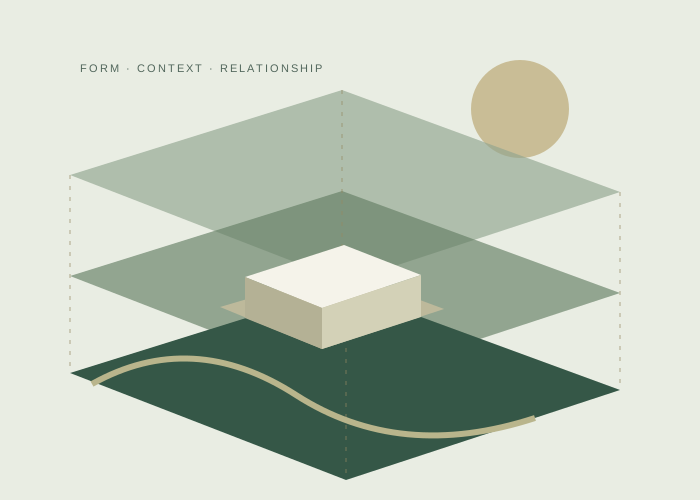
Form and Qi are treated as related, without assuming they are identical. Form can shape Qi, and Qi may influence form. Their expression at different levels, times and scales need not lead to the same result.
Unison of Form and Qi is a brand expression, theoretical direction and research goal. It does not claim that every traditional Li Qi interpretation is scientifically verified.
Advanced learning
A structured research vocabulary.
Unison Philosophy
The wider philosophical direction.
Master You Xiang–Shi School of Feng Shui
A framework for advanced enquiry into form and spatial relationships.
Five Xiang / Five Shi
Named subjects for structured advanced study.
Unison Ten Dynamics
A named part of the advanced theoretical framework.
This introduction does not disclose the complete internal models or professional teaching methods.